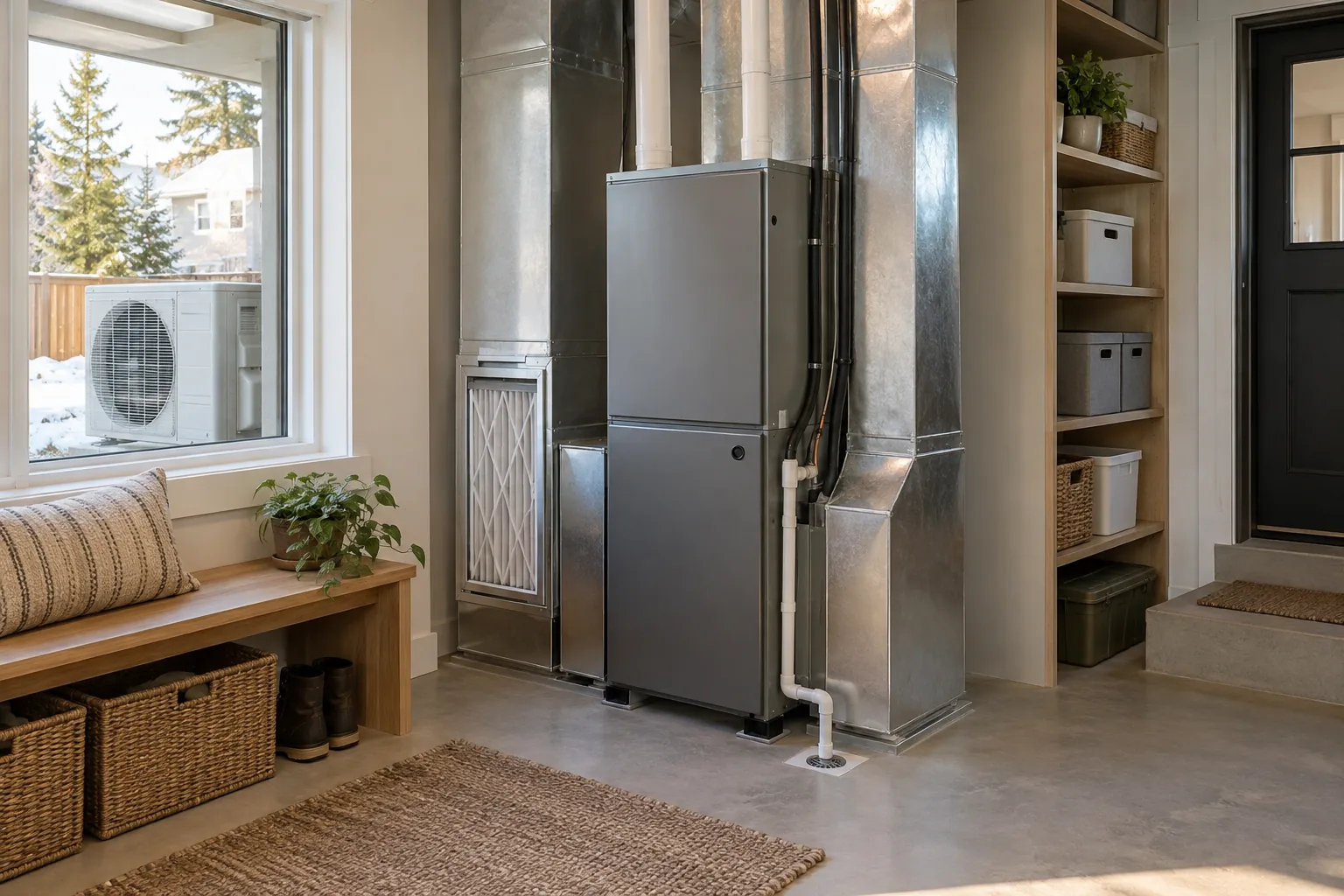
A cold bedroom or overheated living room is a useful starting point, but it is not yet an equipment specification. Comfort depends on heat loss and gain, air movement, humidity, controls, and how the rooms are used. Investigate that pattern before selecting the machine.
1. Record the discomfort precisely
Note the room, time, outdoor conditions, and activity. Is the problem a cold surface beside a chair, a draught at ankle level, warm upstairs air at bedtime, or noise when the system starts? Record whether doors are open, blinds are closed, and other rooms feel different. Simple observations can reveal that apparently similar complaints have different causes. A west-facing room that overheats in afternoon sun and a north bedroom with a draught should not automatically receive the same solution. Share the pattern with the assessor without entering unsafe spaces or opening equipment.
2. Examine the envelope and moisture context
Natural Resources Canada’s Keeping the Heat In guidance treats air leakage and insulation as connected issues. The assessment may consider attic details, wall assemblies, windows, basement conditions, and obvious leakage routes. Moisture must be understood before an assembly is covered or insulated. Health Canada’s guidance advises correcting the cause of dampness; a new lining or coating is not a diagnosis. Discuss which observations need further investigation and how air sealing will interact with ventilation. A tighter home needs a considered fresh-air strategy, rather than an assumption that all existing air movement was beneficial.
3. Review distribution and control
Ask whether useful heating or cooling actually reaches the affected room, whether return paths and closed doors affect operation, and whether the thermostat represents the rooms that matter. Ducts, emitters, zoning, fans, and controls need assessment as appropriate to the existing system. Decorative furniture or a new storage plan may also change airflow. Do not improvise restrictions or equipment changes to force a result. The provider should explain which adjustments are suitable and what can be checked. A better control strategy can be useful, but a smart thermostat cannot repair every distribution or building defect.

4. Select equipment for the home
NRCan’s heat-pump resources emphasize informed sizing and selection. Discuss an appropriate load assessment, climate, available capacity, indoor and outdoor locations, sound, service access, defrost arrangements, and supplementary heat where needed. A product’s headline capacity is not a complete design. Compare ducted and room-based approaches against the spaces you use, the existing infrastructure, and visual preferences. Ask how the proposed system behaves in cold weather and at lighter loads, and which assumptions support that explanation. Avoid promising a particular bill reduction or even room temperature without the assessment and operating context to support it.
5. Compare the sequence using a real scenario
Imagine an upstairs bedroom that is cold in winter while the south-facing living room overheats. An investigation might find attic leakage, weak bedroom distribution, and significant solar gain downstairs. One sequence could address envelope details, confirm ventilation, improve distribution, and then finalize equipment and shading choices. Another might establish that existing equipment is unsuitable and needs coordinated replacement as part of the improvement. The evidence decides. Installing a larger unit first could leave the original room pattern unresolved. Plan the work so final finishes and equipment decisions follow the investigations that influence them.
6. Define what completion means
Ask for the relevant commissioning information, settings, controls demonstration, and operating guidance. Record which checks were made, what conditions applied, and what remains to be reviewed seasonally. A system installed during mild weather may need a later conversation about cold-weather behaviour, with the provider’s responsibilities clarified in writing. Keep filter and service requirements accessible. HAUSE can help organize the lived problem, known equipment, room priorities, and specialist questions into a coherent scope. The useful outcome is a home that is easier to operate and more comfortable in the activities that prompted the work.
Your conversation checklist
- Record room, time, weather, and the specific discomfort.
- Investigate dampness and envelope conditions before finishes.
- Review distribution and control alongside equipment.
- Ask how sizing and cold-weather selection were established.
- Coordinate ventilation after significant air sealing.
- Keep commissioning, settings, and service information.
Questions worth asking
Will a larger heat pump fix uneven rooms?
Not necessarily. The cause may involve the envelope, distribution, controls, or solar gain. Ask for the assessment supporting equipment selection and a clear explanation of how the proposal addresses the affected rooms.
Should insulation always come before equipment?
The right sequence depends on urgency and the existing conditions. Where planned envelope work changes the heating or cooling demand, coordinate it with selection. A provider should explain any need to proceed sooner and how future changes are allowed for.
Turn the useful details into a clear brief.
Choose the services you need and bring your priorities, existing conditions and location into one HAUSE enquiry.
Start my project brief ↗